
We’re reimagining local economies anchored in what really matters.
Guided by clear principles, we’ve begun mapping out how communities can drive meaningful, lasting change to build fair, resilient, and connected local economies.
We’re reimagining local economies anchored in what really matters.
Guided by clear principles, we’ve begun mapping out how communities can drive meaningful, lasting change to build fair, resilient, and connected local economies.

So, what matters?
The economy isn’t just about money.
It’s about people, place, and the ways they interact to create thriving neighbourhoods. We’re focusing on the ideas that make a difference, helping communities share power, ownership, and value. These are the principles that guide how we can build thriving, fair and connected neighbourhood economies:

Human Connection
Relationships are the real infrastructure of prosperity.
Human Connection reminds us that economies should serve people, not the other way around.
Bonds of trust and belonging aren’t “soft”, they’re the very fabric that makes innovation and cooperation possible.

Distributed Power
Decisions sit closer to where life happens.
Distributed Power asks, “Who gets to decide?” When power is centralised in corporations or distant institutions, communities lose their ability to shape their futures. Distributing power – through ownership, participation, and neighbourhood wealth-building – builds resilience and accountability.

Democratic Ownership
People and places share in what they create.
Democratic Ownership ensures people have a real stake in the outcome.
Co-ownership spreads wealth, strengthens local ties, and creates prosperity that lasts.

Shared Value
Reward all contributions that build thriving places, not just capital.
Shared Value recognises that workers, carers, communities, governments and neighbourhoods create value every day, not just investors with capital. Yet our system rewards capital disproportionately. Real fairness means distributing value at the point of creation, not trying to fix it later.
So, what matters?
The economy isn’t just about money.
It’s about people, place, and the ways they interact to create thriving neighbourhoods. We’re focusing on the ideas that make a difference, helping communities share power, ownership, and value. These are the principles that guide how we can build thriving, fair and connected neighbourhood economies:
Human Connection
Relationships are the real infrastructure of prosperity.
Human Connection reminds us that economies should serve people, not the other way around.
Bonds of trust and belonging aren’t “soft”, they’re the very fabric that makes innovation and cooperation possible.
Distributed Power
Decisions sit closer to where life happens.
Distributed Power asks, “Who gets to decide?” When power is centralised in corporations or distant institutions, communities lose their ability to shape their futures. Distributing power – through ownership, participation, and neighbourhood wealth-building – builds resilience and accountability.
Democratic Ownership
People and places share in what they create.
Democratic Ownership ensures people have a real stake in the outcome.
Co-ownership spreads wealth, strengthens local ties, and creates prosperity that lasts.
Shared Value
Reward all contributions that build thriving places, not just capital.
Shared Value recognises that workers, carers, communities, governments and neighbourhoods create value every day, not just investors with capital. Yet our system rewards capital disproportionately. Real fairness means distributing value at the point of creation, not trying to fix it later.
how we’re charting change
Change takes time and intention.
It starts with understanding the challenge and imagining what a stronger, fairer local economy could look like. Our Theory of Change outlines how change can take root and grow over time, guided by practice, evidence, and learning. This is our current view of the pathways that can help communities build more resilient, generative, and equitable neighbourhood economies.
how we’re charting change
Change takes time and intention.
It starts with understanding the challenge and imagining what a stronger, fairer local economy could look like. Our Theory of Change outlines how change can take root and grow over time, guided by practice, evidence, and learning. This is our current view of the pathways that can help communities build more resilient, generative, and equitable neighbourhood economies.
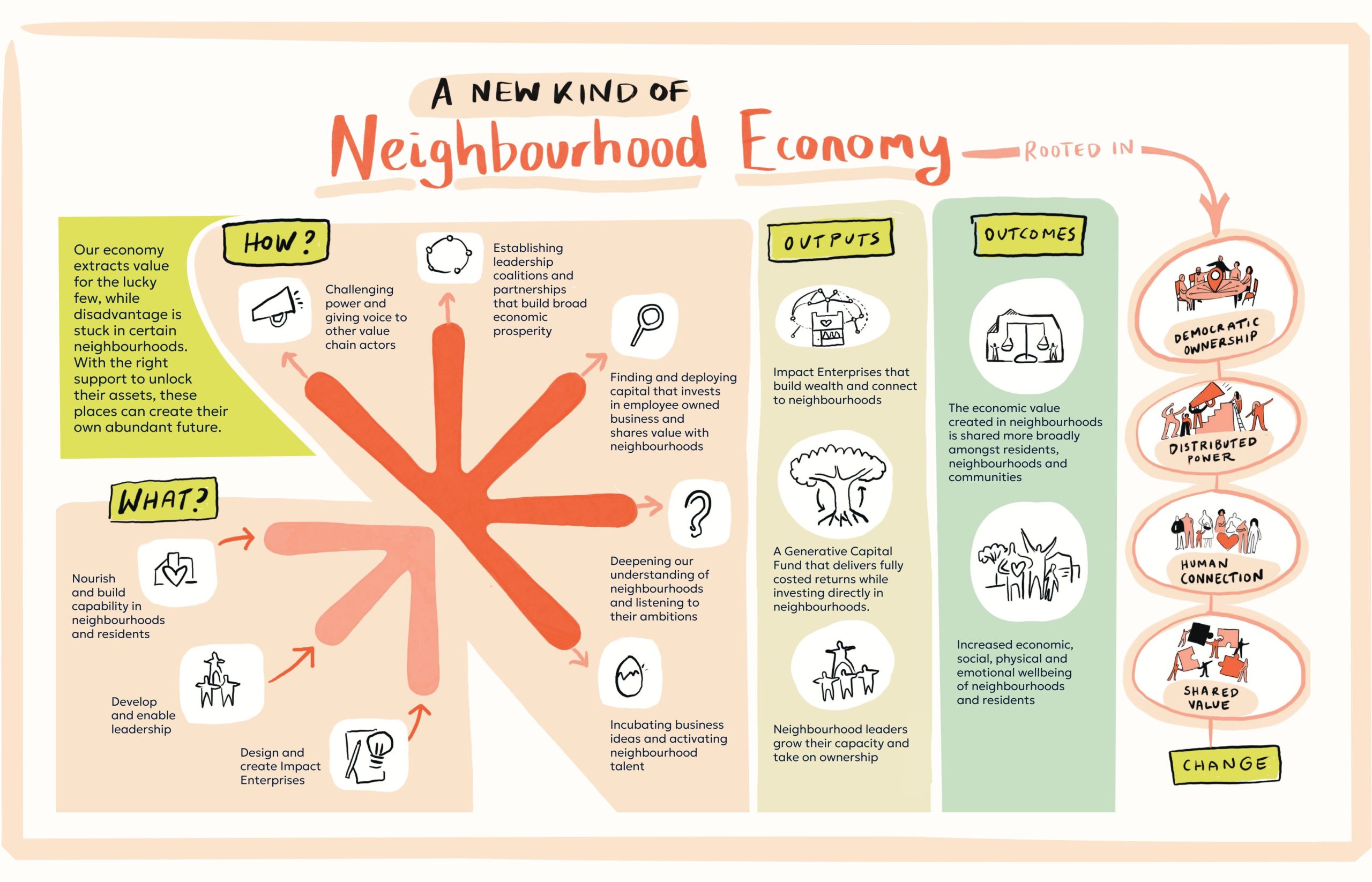
our theory of change
This is the culmination of years of practice and reflection.
It draws from global movements in community wealth building and integrates economic thinking shaped by several frameworks.
our theory of change
This is the culmination of years of practice and reflection.
It draws from global movements in community wealth building and integrates economic thinking shaped by several frameworks.
Stronger neighbourhoods, fairer economies.
We’re working to strengthen communities, share value, and grow economies that truly serve people and place.
By strengthening local ownership, relationships, and decision-making, we’re creating systems that keep wealth and strengthen wellbeing within communities.
Stronger neighbourhoods, fairer economies.
We’re working to strengthen communities, share value, and grow economies that truly serve people and place.
By strengthening local ownership, relationships, and decision-making, we’re creating systems that keep wealth and strengthen wellbeing within communities.